The Full Story
About
This is your About Page. It's a great opportunity to give a full background on who you are, what you do and what your website has to offer. Double click on the text box to start editing your content and make sure to add all the relevant details you want to share with site visitors.

OUR STORY
A story shaped by determination, dreams, and an encounter with a land that transforms.
The drive to explore, the connection to Lake General Carrera, and the conviction to seek a quieter life led them to some of the most powerful places in Patagonia.

In the mid-1940s, Atilio Cosmelli Esteva, then 31 years old, founded the Sociedad Naviera de Chile Chico, a small company dedicated to cabotage on Lake General Carrera. In those years, together with a handful of other vessels navigating the lake, they became a driving force of colonization—connecting people, transporting supplies, and enabling communication.
Their wakes on the water were the roads of our province.
The men and women who lived here faced a powerful and dominant nature; their dreams required steady steps, determination, and a long-term vision.
Every poplar, every fruit tree would take years to bear fruit and provide shade. What little was produced was loaded onto pack animals to be taken to Argentina, or shipped by boat to the same destination—returning with what could not be produced in our land.
Atilio, from a seafaring family, had fought in the Spanish Civil War.
After it ended, a need to seek new ports grew strong within him; solitude and the unknown seemed essential. The atrocities of the war stirred in him a search—a hunger to explore, a need for solitude, a desire for encounter, perhaps with himself or with that vastness that makes you feel small. Chile emerged as a destination, and the stories and tales of a mysterious, unexplored land seemed to take hold in Atilio’s mind.


After a year living in Magallanes—learning about the cold, the solitude, the horses, and above all, the mastery of will—he was ready to venture into the promised land, an unknown and inhospitable region. His undertaking would not be immediate: in 1941, he was tasked with bringing a sailing schooner from New York to Chile, a journey that would last three months. After this, he was ready to depart.
He set off knowing, deep within, that he would return for someone.
He bought a horse and, with his Castilian blanket, set off on his journey. After months of traveling, one afternoon—tired, soaked to the bone, and no longer certain why he should keep going—he stopped and asked himself, “What am I doing here?”
Then, far off in a valley, he saw smoke rising from a small shack made of rough canogas wood—a shelter in its most rustic and ancient form: dirt floor, raw timber pieced together to protect against the rain and the winds that sing and lash through this land. A shelter as solitary as the one who lived in it, set within a vast and dominant nature.
Two dogs barked. A man stepped out and saw the traveler—wet, alone. Who was he? Where had he come from? At last, the voice of the land prevailed: “Dismount,” the man said. When Atilio got down, the man saw that nothing on him was dry, and that the overcast sky threatened only more rain. “Unsaddle,” came the voice again, echoing with the authority of the land—there would be shelter for the night.
Inside the shack, as he drank a bowl of soup, the answer came to Atilio: “This is why I am here. This is heaven.” It echoed in his mind and settled in his heart. The wounds of war seemed to begin healing in the beauty of that welcome, in the fullness of simplicity. Solitude was no longer harsh, his will grew strong—he had found his home: Aysén.

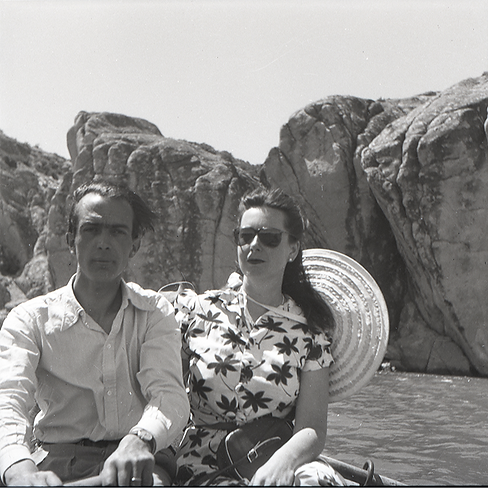
Atilio returned to Santiago—he had already found his place: a small border town on the southern shore of Lake Buenos Aires. This time, his journey had another purpose.
During a stop in Valparaíso, after sailing for three months from New York to Chile, he had met a woman. A few hours were enough to share dreams and sketch horizons—they spoke of that mysterious land, of its unknown “City of the Caesars.” It had been brief, but their glances and words struck deep, taking root strongly enough that dreams became determination, and his will overflowed into this adventure in Aysén.
In June 1945, Atilio Cosmelli Esteva married Luz Pereira Lyon.
Her family had ties to Aysén, as her father, Ismael Pereira Iñiguez, was the founder and president of the Sociedad Ganadera Río Cisnes Ltda, which operated the Estancia Río Cisnes—one of the three major concession-holding estates in the region, and in which her family was the principal shareholder.
Far from that reality, Luz’s upbringing was shaped more by salons, parks, travel, and care than by the Aysén that awaited her. Chile Chico seemed, to her entire family, like a lost outpost—remote, without connectivity, an unknown town of pioneers.


And so, there was already a family, an immense lake to navigate, families to connect, places to explore, homes to build, land to till, and hands to harvest.
From the deck of the Estrella, one place stood out—its long plateaus concealed arable plains, and its northern exposure made it ideal for the harsh winters of Aysén. And so, the land was first dreamed, then poplars were planted, canals and paddocks were built, houses and outposts were raised; years later, the gaucho would tend the livestock.
The lands of San José—La Naviera—were born from the water, and they are the lands we inhabit today.
La Naviera played an important role in the communication, trade, and settlement of the General Carrera Province. The maps of the lake were drawn from a desk, where Atilio Cosmelli Esteva carefully traced what he discovered in every corner, bay, and current—identifying each settler, each family.


In 1958, Atilio Cosmelli Esteva was appointed governor (intendente) of the then “Province of Aysén” (now the Aysén Region). As a result, he and his entire family relocated to Puerto Aysén, the capital at that time.
A few years later, following the sinking of the Estrella, the Sociedad Naviera de Chile Chico ceased its cabotage operations on the lake.
San José de Mallín Grande—La Naviera—however, would continue operating.
Hasta el corazón de lo desconocido, en algún lugar elegido abatieron los coihues,
gigantes de nuestros bosques,
rozaron los fachinales, y a la orilla de un arroyo
levantaron sus taperas de canoas…
Después de muchos años, un día germinó la pradera…
el tiempo había transcurrido inexorablemente…
el cansancio les llevó al lado del fogón
donde hicieron recuento de los mejores años de su vida,
de todas sus luchas e ilusiones.
Dieron una mirada interior de contemplación
a su campo y a su obra,
que en ese momento
silenciosamente legaban a sus hijos…
— Atilio Cosmelli.
